

You're optimizing the wrong number
Most businesses track one aggregate number: how many visits end up with an order. The problem is that there are more funnels - registration, repeat purchase, solving a customer's problem.
Example: A hair growth product manufacturer had great campaigns, but customers weren't coming back. Reason? The product must be applied twice a day for two months. People didn't catch it, hair didn't grow and bad reviews came out.
"The customer always prefers to blame you for his failure rather than himself", says Lukáš.
The funnel does not end with payment. It only ends with the correct use of the product.
What to really measure
Measure what brings money. In an e-shop, it is often not an order, but a purchase that the customer does not return. For dietary supplements, the first purchase followed by the second.
One of the e-shops with contact lenses openly said that it loses money on the first order - it will only make money from the third. That's why he optimized Funnels for people with the highest chance of doing it.
Quality is the deciding factor when it comes to demand. The manufacturer of prefabricated buildings (average order 700 to 800 thousand crowns) scores requests using AI and optimizes the website and marketing mainly for high-quality ones. In this way, traders do not needlessly go after people who refuse a price twice as high as that of the competition.
Beware of the trap: Raising the conversion rate is easy - turn off campaigns and leave only direct traffic. Want more requests? Shorten the form. In five days you have three times the leads. But they are of poor quality, the store is not keeping up and customers are standing in line.
A business goal is not a conversion rate.

Data will tell you what, but not why
When the conversion rate drops from 5% to 3%, the agency usually goes to the rug. Most often, however, the funnel did not deteriorate - the composition of traffic changed, for example after the launch of acquisition campaigns.
Lukáš therefore breaks down the numbers by source, landing page, device, campaign, browser, day, hour and region. When the problem is only in some sources, the source is solved, not the site.
But the data does not lead further.
"They'll say back what happened and how much happened. They won't say why it happened."
Why AI is not enough on data
The brain makes up the missing explanation. Everyone has their own theory about the dashboard.
It is therefore risky to connect to AI data and let it propose and deploy changes by itself. Lukáš is already receiving requests such as "our agent flow killed 60% of our sales".
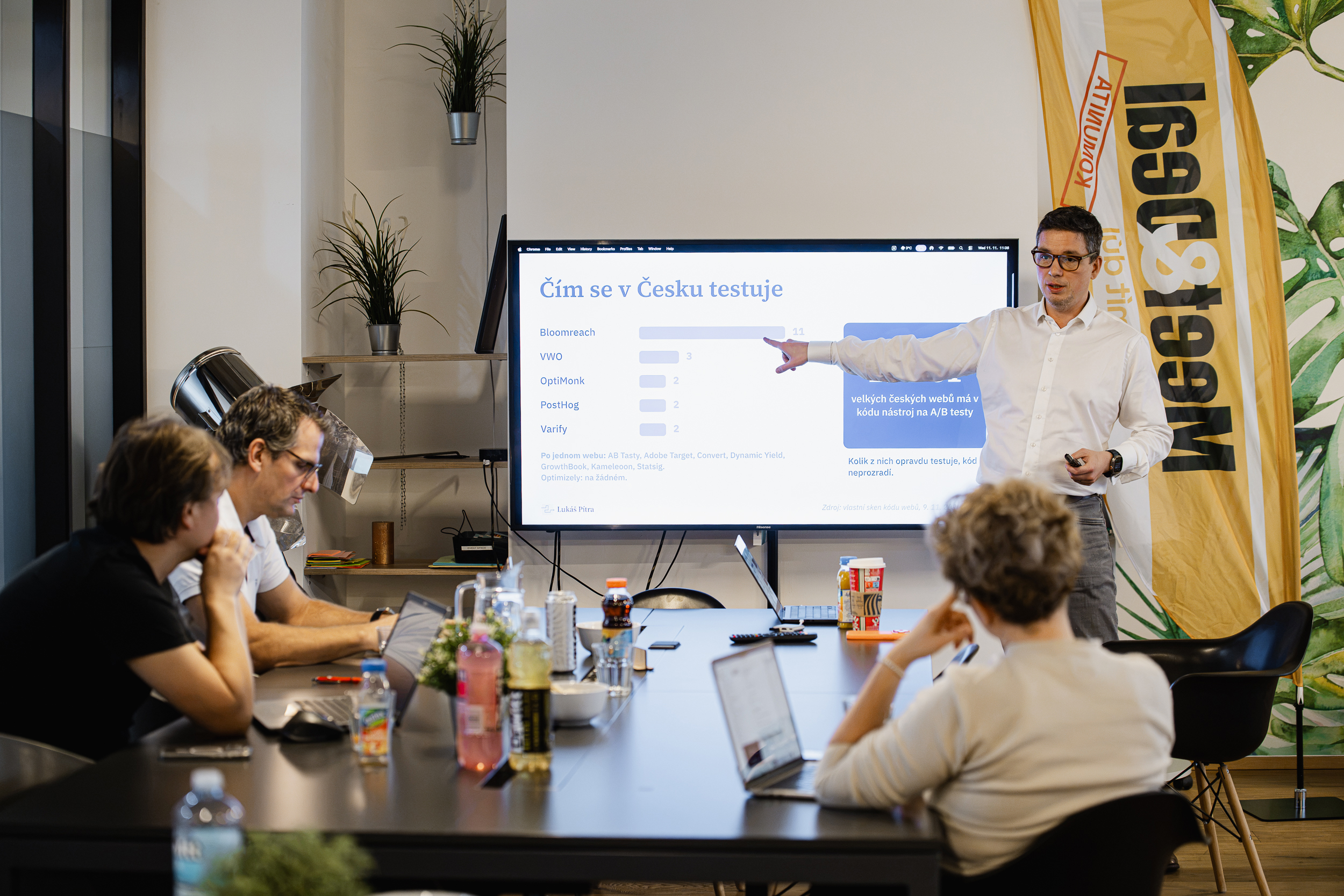
Ron Kohavi, who ran experiments at Microsoft, had people guess the results of eight A/B tests there for ten years. They hit an average of 2.3.
Do not rely on estimates. Supplement data with methods that reveal the reasons.
How to Uncover the Reasons (Checklist)
1. Feedback Follow-up Calls
After a key step in the journey, ask users how easy the process was (Customer Effort Score), then call those who gave the lowest ratings.
Example: A major e-commerce site discovered via their "thank you" page that users participating in a voucher campaign were struggling to redeem their coupons. This was a major stumbling block, even for many who ultimately didn't complete a purchase.
For a solar panel (photovoltaic) provider, customer satisfaction was high right up until the contract was signed—then it plummeted. The reason? Sales representatives were promising anything just to secure a signature. Customers later learned they weren't actually eligible for the subsidies they had been promised.
2. User Testing
Only about one-fifth of projects conduct this.
Example: A swimming pool manufacturer implemented a new conversion block, and their conversion rate dropped by 90%. User testing revealed that male visitors didn't even notice the call-to-action (CTA) for requesting a quote.
How to test:
- Use people who fit your target demographic and are potential buyers—not just friends or neighbors.
- For e-commerce, focus on your competitors' customers (your own existing customers have already overcome the barriers to purchase).
- Test in real-world conditions—on a mobile phone, in direct sunlight, with children around, or while on a bus.
- Include at least seven participants.
3. In-depth Interviews
An online store selling cannabis-based ointments had a conversion rate of 2.3%. Interviews revealed that customers didn't know what constituted a "high" amount of cannabis—specifically, whether it should be measured in milligrams or as a percentage. So, the website started presenting the cannabis content in a simple way: by highlighting that there’s a whole lot of it.
The conversion rate jumped 2.5x overnight; today, it sits at nearly 6%.
You won’t find an insight like this in GA4, AI won’t tell you about it, and customers won’t mention it in their feedback either.
4. Questionnaires
A producer of flavored honey found that only 18% of their customers were returning. A questionnaire revealed that customers simply couldn't finish the honey—they’d put the chili-infused honey on a bread roll a few times, but then didn't know what else to do with it.
Once the company started sending out recipes—such as one for a blue "Smurf-style" porridge made with honey and spirulina—moms bought up the entire stock.
An "opportunity gap survey" (OGS) is highly useful: for each attribute, you ask how important it is and how easy it is for the customer to find.
Example: In the case of swimming pools, it turned out that assistance with excavation was highly valued but difficult to find. The company began highlighting that they could arrange the excavation through a partner—and went on to have a record-breaking year.
Thanks to an OGS, a garden supply retailer discovered two product categories with nearly double the profitability.
"Conversion becomes incredibly easy when you’re selling the right things."
5. A/B Testing – Save It for Last
A/B testing only makes sense once you understand the "why" and have sufficient data. Most Czech projects lack this—you need tens to hundreds of thousands of page views and, roughly speaking, thousands of conversions. For a smaller e-shop with 15,000 visits, roughly 80% of the "winners" identified after a four-week test are actually false positives.
A/B Testing Rules:
- Do not end a test prematurely.
- Pay attention to duration: shopping behavior differs between the beginning of the week and the weekend, and between the first and second halves of December.
- Watch out for uneven traffic distribution (e.g., a higher proportion of mobile users in one variant).
- Do not rely solely on proxy metrics, such as "add to cart" actions.

Changes Fail to Reach Completion
When mapping the customer journey, team members often disagree on what the journey actually looks like, and everyone cites different figures. Furthermore, the specific step where the highest number of users drop off is frequently left without a clear owner.
Or, there might be an owner, but they lack the authority to act—for instance, a marketing director whose web agency has a turnaround time of a full quarter for a single task.
"Conversion rate optimization begins with having a dedicated person in charge who actually has the power to address it."
Another obstacle is haste: the most influential person in the company proposes a solution, and it is implemented immediately.
The Double Diamond Framework
Lukáš utilizes the "Double Diamond" framework: he first explores and then narrows down the problem, repeats this process for the solution, and conducts research throughout.
A honey producer once considered lowering prices; however, while the resulting campaign sold slightly more honey, margins suffered, and return rates remained unchanged. It was only through research that the true root cause was uncovered.
When can you make a decision from your desk? When the cost of a failed change is no greater than the amount you would be perfectly comfortable losing on a single bet on "red" at a casino.
For major decisions—such as those concerning your offer, pricing, or value proposition—wait until the approach has been validated by at least two, or ideally three, different methods.
Regular Rituals
To ensure that changes are actually implemented, Lukáš establishes regular "rituals": each owner of a specific segment of the customer journey receives a tailored report, along with a status update that includes a pre-defined action plan. The goal is not to talk about numbers, but to leave with well-defined tasks that have an assigned owner, a deadline, and sufficient information.

Two Overlooked Levers
Accessibility
Accessibility is not just about people with permanent disabilities (in the Czech Republic, this accounts for roughly 15% of the population over the age of 15). Limitations can also be temporary—such as a broken wrist, fatigue, or caring for small children—or situational, like using an inexpensive phone with low screen brightness while out in the sun.
According to the European Commission, at least 70% of users find themselves in such a situation during a typical week.
Users who encounter difficulties on a website usually just leave; only about 8% of them reach out to report the issue.
Accessibility Checklist:
- Text-to-background contrast (at least 4.5:1)
- Form field labels
- Size of buttons and links
- Alternative text for images
- Conversion buttons remain visible when the page is zoomed in
- Pop-ups can be closed using the keyboard
Tools like WAVE or AI-based automated checks can help.
Furthermore, the European Accessibility Act (EAA) comes into full effect in June 2025. The Czech Trade Inspection Authority (ČOI) has already conducted 47 inspections, ten of which revealed non-compliance.
Forces Resisting Change
The "Forces of Progress" model describes four dynamics: dissatisfaction with the current solution and the appeal of a new one drive change, while anxiety and habit act as opposing forces.
Habit is the most overlooked factor.
For an e-shop that is not the market leader, habit is often the single greatest obstacle. A smaller electronics retailer doesn't necessarily need to worry about how to better describe a product, but rather how to convince people not to shop at Alza—where they are already accustomed to buying.
According to Lukáš, the fact that communication fails to cover all four forces is the most common problem he encounters during conversion optimization.
 !
Investigate first, change later
When one of the participants asked Lukáš for quick feedback on his website, Lukáš pointed out that—without research and data—his advice would likely be off the mark.
That is the core of his approach: fewer changes based on guesswork, more digging into the "why."
The result? A significantly higher chance that changes will actually work—and less money wasted on those that wouldn't.